The Lenses Klarna Skipped – and Why Every Decision Needs Three
Oct 9, 2026
Every growing business hits these moments: hire someone new, launch a service, invest in tech, expand into a new market. It's exhausting just to list them – and when decision fatigue sets in, the shortcut is to let whichever lens is loudest in the room make the call.
The finance person wants to know if the numbers stack up. HR and operations want to know what people, skills and capabilities will be required, and the product and marketing teams want to know which customers it's serving. The reality is that it is often not easy to step back and actually consider all lenses equally and adequately, at the same time, before it's locked in.
Take Klarna. Back in 2024, the global fintech said its new AI assistant was doing the work of around 700 customer service agents. The finance case looked airtight – the AI handled over two million conversations in month one, slashed resolution times, and was projected to deliver a US$40 million improvement in profit in its first year. On paper, it was a clear win.
A year later, its own CEO was walking it back. Customers weren't happy. Complex issues weren't getting solved. It started rehiring humans, not because the AI didn't work, but because the decision had been run through a finance lens almost exclusively, without really asking what customers needed or whether the business was set up to deliver support that way. Its CEO later admitted cost had been "a too predominant evaluation factor."
Klarna isn’t alone. Gartner now predicts that by 2027, half of the companies that cut customer service staff because of AI will rehire people to do similar work – just under different job titles. Businesses of every size make the same mistake: a decision made too narrowly, by people too close to it to see what they were missing.
In hindsight, the way it should have been done seems logical, almost easy. We all know the right way in theory. But with time pressure, incomplete information and constant interruptions, considering every lens takes deliberate effort.
So, before you lock in a significant decision, get the people who hold each lens into the room. Customer, People and Finance are the three lenses almost every business decision touches, which makes them the essential starting point, not the finish line. Make sure all three actually weigh in, not just get told about it after the fact.
Each lens asks different questions. The Customer lens looks at the decision from the perspective of the people your business exists to serve. It means starting with what you already know – your customer data, client satisfaction, complaints, support queries – then filling the gaps with conversations and perhaps a survey. The People lens asks whether your team, including you, has the skills, capacity and buy-in to deliver it. The Finance lens tests the real cost, how you’ll fund it, and what happens if your assumptions are wrong.
Depending on the decision, other lenses matter too: legal, risk, compliance, and more. But if you're not even covering the first three, adding a fourth or fifth won't fix a decision that was already too narrow.
As the Customer lens in our trio, I’ll admit my bias: it’s the one I see skipped most often, especially when something looks like a tech or cost decision on the surface. Anushka would say the same about Finance, and Natalie about People – and that’s exactly the point. Each lens gets skipped by someone. Klarna’s cost numbers were real. What it missed was what customers needed and whether its team was set up to deliver.
Where it gets harder is when you don't have three specialists sitting around your table, or when you're the owner wearing all three hats at once. Knowing that customer, people and finance all matter is one thing. Actually applying someone else's expertise to your own decision, from inside it, is a very different thing. That's where having a peer, an advisor, or just a trusted outside voice earns its keep – someone who represents the lens that isn't your strength. Not to make the call for you. Just to pressure-test it with you before you commit.
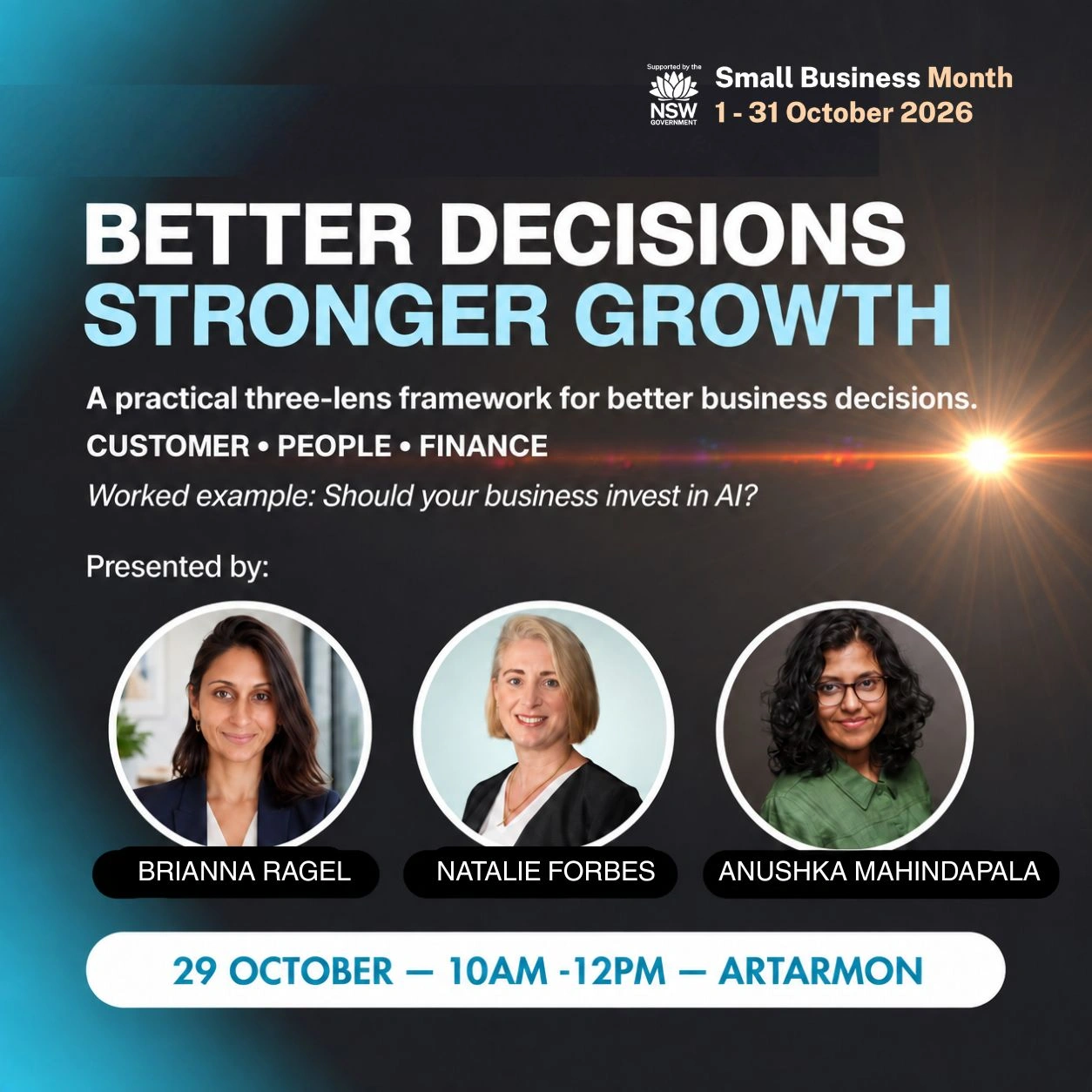
That's exactly why I've teamed up with Anushka Mahindapala from Decision Consulting (Finance) and Natalie Forbes from CulturePath HR (People) for Better Decisions, Stronger Growth, our NSW Small Business Month session on 29 October in Artarmon. Between the three of us, we'll bring those lenses to life using AI investment as the worked example. We're also hoping to bring together local leaders from professional services, health, trades, property, education, not-for-profits and beyond – a genuinely mixed room, and maybe a chance to meet the peer who can help you see through the lens that isn't yours.
Decision fatigue is real. Business risk is real. Find an outside view when you can't cover all three lenses yourself. It works for AI, and for pretty much any decision that actually matters.
Better Decisions, Stronger Growth
Thursday 29 October, 10am–12pm, Artarmon Sydney
A practical Customer, People, Finance framework for pressure-testing significant business decisions, worked through live, using AI investment as the example.
Limited seats. Tickets and details: events.humanitix.com/better-decisions-stronger-growth
Proudly part of NSW Small Business Month 2026.
Weighing a big decision and want the Customer lens on it? Get in touch.